

5 co-regulation tips to help your toddler manage their feelings

When your toddler is upset, it can be hard to know what to do ❤️
During the newborn stage, you helped your baby calm down by holding them, rocking them, and taking deep breaths. Now the process is getting more complicated. Your child’s emotions become more complex as they get older. Sometimes they don’t want to be held or the strategies that were so reliable a few months ago don’t work.
Co-regulation is the process of showing your toddler how to manage emotions by doing it together. This can be difficult but effective. The next time your toddler is upset, try these five expert tips.
1. Acknowledge their feelings
Sometimes all your toddler needs is to know that they’re understood. If your toddler starts crying because the cat ran away from them, try simply stating in a calm and empathetic tone, “You really wanted to pet the cat.” This can be a surprisingly effective way to handle those big feelings before they get out of control.
2. Match your toddler’s emotional tone but not the volume
Whether your toddler is really, really excited or really, really distressed, using a softer version of their emotional tone can help them start to regulate. If your toddler is crying hard because their grandmother had to go home, you could say in a sad voice, “You are so disappointed that Grandma left. I am sad about it, too.”
3. Help your toddler understand the situation
If your child is frightened, stating what happened can ease their anxiety. “I heard that loud noise, too! That was the rubbish truck driving by. Let’s see if we can see it outside.” Demystifying the causes of distress can help your toddler regulate the next time they get startled.
4. Try positive redirection
Redirecting your toddler’s attention away from whatever upset them can be an effective strategy when timed right. If your toddler is in the midst of a major meltdown, distracting them with a fun toy probably won’t work. But if they’re a little frustrated or sad or starting to calm a bit after an emotional storm, research shows that redirection and distraction can be helpful.
When you redirect your toddler’s attention, try shifting it to something that meets a similar need. For example, if your toddler is sad that the cat doesn’t want their affection, you could find a cuddly toy for them to pet: “Charlie doesn’t want to be petted right now. Let’s see which one of your cuddly toys is the softest and give it some cuddles together.”
5. Co-regulate
After acknowledging your toddler’s feelings, try quietly holding them or sitting close. At times, talking can add to their emotional overload. Take a few deep breaths, relax your own body, and let them know you’re there for them with your calm presence. Sometimes, your toddler needs to experience their feelings before they can start to breathe more slowly and relax their body to match yours.
Learn more about the research
Deichmann, F., & Ahnert, L. (2021). The terrible twos: How children cope with frustration and tantrums and the effect of maternal and paternal behaviors. Infancy, 26(3), 469-493.
Eisenberg, N., & Sulik, M. J. (2012). Emotion-related self-regulation in children. Teaching of Psychology, 39(1), 77-83.

Keep reading
11 - 12 Months
13 - 15 Months
16 - 18 Months
9 - 10 Months
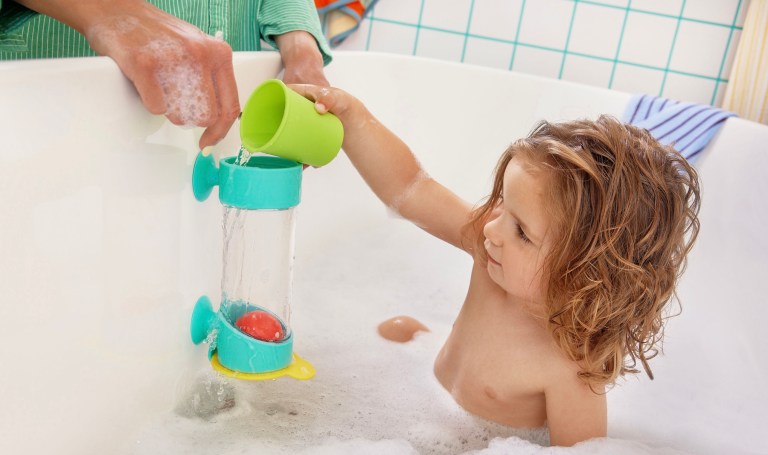
The surprising ways bathtime builds your child’s brain
When it’s just you and your child, face to face, bathtime becomes a natural opportunity to connect, play, and develop your baby’s brain. And The Bath Set includes thoughtfully designed tools for building new language, cognitive, and fine motor skills.

16 - 18 Months
Introducing 3 new playthings to The Adventurer Play Kit for months 16, 17, 18+
The Adventurer Play Kit has three new playthings to keep your toddler engaged and challenged through play.
22 - 24 Months
25 - 27 Months
28 - 30 Months
31 - 33 Months
34 - 36 Months
Our favourite birthday and holiday gift ideas for 2-year-olds
These fun gift ideas for 2-year-olds support their motor skills, independence, and creativity.