

4 early gravity lessons

They drop it, you pick it up; they drop it again, you pick it up again. There is nothing toddlers love more than learning about gravity. Gravity is one of the foundational cause-and-effect sequences that explains why something falls.
Here are some fun early gravity experiments for your budding explorer:
Sliding and rolling
Start with an incline, like a slide at the park or a piece of stiff cardboard propped against the edge of the couch. Give your toddler various objects to roll or slide down the ramp, like the Opposites Balls, wadded up paper, a wooden car, and even something that won’t slide, like a banana. You can say “let’s see which one slides (or rolls) the fastest!”
Some things fall faster than others
Hold your toddler while you’re standing and have them drop—one by one—the Bright & Light Play Scarf, a flat sheet of paper, a crumpled up piece of paper, a crayon, the Bunnies, or anything else you can think of that is easy to pick up. Then talk about how some things fall faster than others, because lighter objects are more affected by the air around them and take longer to hit the ground. Be ready for your toddler to want to do this over and over again 😁
Up in the air
Outside or in a room with some space, toss a soft ball up into the air and watch together as it falls down again, saying “first it goes up, then it goes down.” If you’re outside, you can fill a container with water and empty it into the air to show your toddler how liquids are affected by gravity.
Toss the Wooden Coins into a large bowl, bucket, or laundry basket, experimenting with different distances. Practice dropping at first before moving on to tossing, making sure the container is close enough and large enough for your child to be successful.


Keep reading
11 - 12 Months
13 - 15 Months
16 - 18 Months
9 - 10 Months
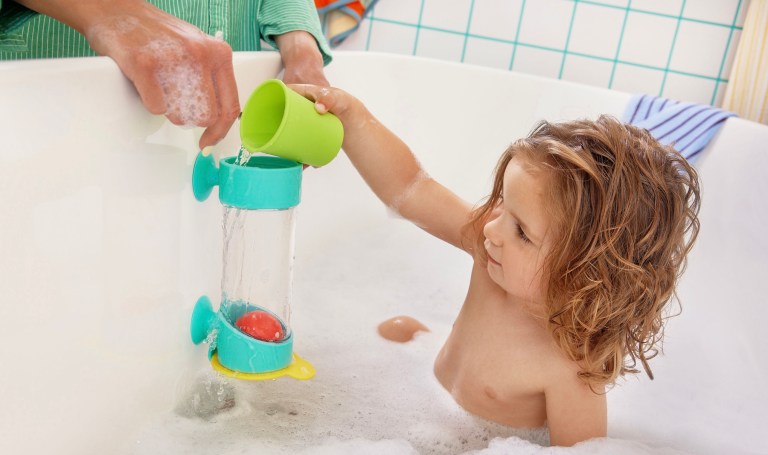
The surprising ways bathtime builds your child’s brain
When it’s just you and your child, face to face, bathtime becomes a natural opportunity to connect, play, and develop your baby’s brain. And The Bath Set includes thoughtfully designed tools for building new language, cognitive, and fine motor skills.

13 - 15 Months
16 - 18 Months
19 - 21 Months
22 - 24 Months
5 co-regulation tips to help your toddler manage their feelings
When your toddler is upset, it can be hard to know what to do ❤️ During the newborn stage, you helped your baby calm down by holding them, rocking them, and taking deep breaths. Now the process is getting more complicated. Your child’s emotions become more complex as they get older. Sometimes they don’t want … Continued

13 - 15 Months
16 - 18 Months
19 - 21 Months
22 - 24 Months
Wish your toddler would focus? Try playing together first
When you read a book or practise stacking blocks with your toddler, you do more than bond with them. You also help increase their attention span ❤️ Two related studies published in 2019 and 2022 found that when parents and their toddlers focused on a toy together, the toddlers paid attention a little longer and … Continued