

The Reading Skill Set: All the research on the best ways to help your child learn to read

Helping your child get off to a strong start with reading is one of the most valuable gifts you can give them. Children around the world face different challenges when learning to read, and literacy remains a global concern across educational systems and languages. The causes of reading difficulties are complex, but one thing is certain: regular practice at home makes a big difference.
That’s why Lovevery developed The Reading Skill Set. We began by studying decades of research on the most effective ways to help children learn to read. Then we combined that knowledge with what we already understand about how they play and learn. Many of the parents we spoke with during our own research felt overwhelmed by the responsibility of teaching their child to read. But The Reading Skill Set doesn’t ask you to be your child’s teacher – it invites you to be their coach ❤️

Each game focuses on one phonics skill, so you and your child can keep playing until you both feel ready to move on. Once they’ve gained enough skills to begin reading, the books in The Reading Skill Set use controlled text. This means your child will only encounter the phonics rules they’ve already practised, along with a small set of words that don’t follow predictable spelling patterns. We call these “sticky words.”
Learning to read might be hard for your child, but they already know how to play. That’s why play has been at the heart of The Reading Skill Set from the start. After so many decades and countless studies, the research is clear on the most effective ways to teach reading. The tricky part is keeping a child motivated and engaged all the way through the process.
Play is the key – and Lovevery understands play. We’ve made sure every element of The Reading Skill Set is fun, motivating, and grounded in best practice, so you can support your child to become a fluent, confident reader – and enjoy it together ❤️
Here’s what the research says about how children learn to read
Reading programmes are most effective when they include the 5 Big Ideas of Reading2,3
There’s no shortcut to learning to read – it’s a complex skill made up of many interrelated components. The Reading Skill Set incorporates the 5 Big Ideas of Reading: phonemic awareness, phonics, fluency, vocabulary, and reading comprehension.
These five elements are most effective when taught together. Before a new reader can use phonics rules to decode words, they need phonemic awareness to help them hear the sounds within words. Fluency and comprehension come once your child has read enough text to recognise and understand it almost instantly. The comprehension questions at the end of each book help to build this skill.
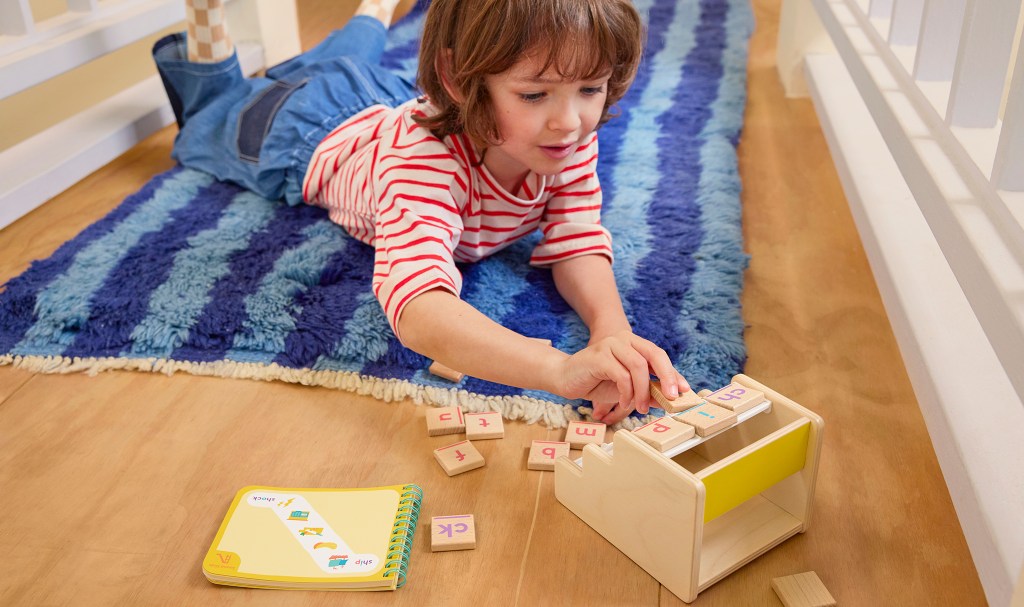
Decades of research show that phonics-based instruction is the most effective way to help children learn to read3,4,5
A phonics approach teaches your child to recognise each letter form and connect it to its most common sound. Once they can do that, they can begin blending sounds together to read words and sentences.
That’s why The Reading Skill Set guides your child through a structured phonics progression of letters and their associated sounds. Historically, phonics has sometimes been criticised as overly repetitive or reliant on drills – but it doesn’t have to be. The Reading Skill Set features playful games, interactive activities, and engaging books with relatable stories.
The programme begins with a concept known as phonological awareness – the ability to hear sounds within words. The smallest unit of sound, and the most difficult to isolate, is called a phoneme. Phonemes include single letter sounds as well as digraphs – two letters that combine to make one sound. For example, the word path contains three phonemes: /p/, /a/, and /th/. Being able to isolate sounds is just as important as knowing the sound each letter makes.
The Wooden Letter Sound Blocks combine phonological awareness with the key phonics skill of identifying which sound each letter represents. Within a set of four blocks, your child must find the sides that begin with the same sound. When all four matching sides are correctly positioned, the corresponding letter appears on top. Each group of six phonemes and letters is designed to avoid confusion with visually similar characters, such as p, d, q, and b.
Parts 2 and 3 help your child build the phonics skills needed to blend and segment words – eventually reading longer words with more complex phonics patterns. To succeed, they’ll need practice, repetition, and a thoughtfully sequenced approach.
Children who work on literacy skills at home often have a stronger reading foundation6, 7
Research suggests that children whose parents introduce early reading skills at home tend to have an easier time when they start school. But you don’t need to be a literacy expert to help your child learn to read. Well before formal reading instruction begins, you can support your child by helping them learn new vocabulary and foundational skills – like recognising letter sounds or breaking words into syllables.
So how do you start? Being your child’s reading coach might sound daunting, but The Reading Skill Set makes it as simple as playing a game or reading a book.
- Each game targets a single skill and can be played independently or together.
- The books only include phonics rules your child has already practised, plus a small list of irregular “sticky words” to gradually build fluency and confidence.
- Comprehension questions at the end of each book prompt your child to reflect on what they’ve read.
- The Parent Guide that comes with each part helps you feel prepared and reassured as you support your child.
Children make more progress when they practise a skill before reading a book8
Trying to read a book before practising the related phonics rule can quickly lead to frustration. The Reading Skill Set helps you avoid these moments by introducing every new skill with a game or activity. Your child can build confidence through play before applying the skill to reading.
You may have heard the term “decodable” used in relation to early reading. Good decodable books encourage children to decode words rather than guess. But they only work if your child has already learned the skills needed to read them. By pairing each book series with a game, the Set increases the likelihood that the books will truly be decodable for your child.
Part 1 includes more games than books to help build phonological awareness alongside early phonics and comprehension skills. It finishes with a set of turn-taking books for you and your child to read together, supporting stamina and motivation.
In Part 2, your child begins reading their first books independently. Games like Crossword Builder and Sticky Word Snack Sticks help them recognise tricky words and apply the phonics rules they’ve learned so far.
Part 3 includes more books than games. After completing this part, your child will have read their first books with uncontrolled text – similar to the books they’ll encounter in a library or bookshop.

Children prefer to read – and reread – books they relate to9
Your child is more likely to practise reading – and even look forward to it – when the characters and stories reflect their own life. This can be hard to find in early reader books, which often contain very few words. The Reading Skill Set includes the same compelling storylines, vibrant photography, and relatable characters as other Lovevery books.
To capture the attention of beginning readers, the books use humour, playful scenarios, and engaging visuals. There are nine series covering a range of genres – including mystery, non-fiction, and even elements of comic books. Surprising features – like a tool that reveals hidden text and a time capsule filled with envelopes to open – keep your child motivated as the reading becomes more advanced.
Appealing to different interests makes it more likely your child will find a favourite book – one they’ll want to return to again and again. Their fluency and comprehension grow each time they reread the same book. Familiar texts allow them to read with greater speed, expression, and confidence. It also helps them recognise “sticky words” at a glance, instead of needing to decode them every time.
Children learn best through playful sensory experiences without screens10,11,12,13
Research shows that when children use multiple senses – such as touch, sight, and sound – they gain a deeper understanding of what they’re learning. The Reading Skill Set includes tangible materials to engage your child and help them grasp abstract ideas, like letter sounds and syllables. While reading apps can be entertaining, without something physical to hold or manipulate, concepts can remain too abstract.
One of these concepts is known as vowel teams – combinations of letters that produce predictable vowel sounds. For example, oe typically makes the long “o” sound, and -igh usually makes the long “i” sound. Although the alphabet contains only six vowels, English includes up to 20 different vowel sounds.
Just like learning each letter’s most common sound, recognising vowel teams by heart helps improve fluency. But memorising them can be challenging – especially since many vowel teams produce more than one sound. This is where many phonics programmes – even apps – rely on rote memorisation. The Reading Skill Set relies on penguins 😉
In the Vowel Team Penguin March game, the goal is to balance as many penguins as possible on a single iceberg. Your child hops penguins from word to word, reading each one aloud. If the penguins lose their balance and fall, the game resets. The challenge of balancing all eight penguins keeps your child engaged – helping them commit these key vowel patterns to memory.
Oral language and storytelling skills improve reading comprehension14,15
Storytelling is often overlooked in reading instruction. Each time your child hears a story – or tells one – they learn new vocabulary, expressions, and how to construct sentences. Research shows that when adults tell stories, they often use more advanced vocabulary than what’s found in books – so there’s no need to simplify your words.
Telling stories helps build the background knowledge your child needs to understand and enjoy books. For example, a story set in a forest can introduce names of different trees and animals. As you tell a story, ask your child questions along the way. This encourages them to infer meaning from context – a key higher-level comprehension skill. You might ask, “How do you think the frog felt when her lily pad ripped? What makes you think that?”
Storytelling also helps your child understand how narratives work. “Story grammar” refers to elements like characters, setting, plot, conflict, and resolution. Once your child begins reading books independently, they’ll need to be familiar with these concepts to follow what’s happening. Sharing and creating stories now gives them valuable practice.The Set the Scene Storytelling Stage gives your child the chance to create original stories based on prompts. As they narrate, they use props and backgrounds to add detail. Partway through, they’re prompted to introduce a twist – a problem or conflict to solve before the story ends.
Learn more about the research
1 National Assessment Of Educational Progress. Nation’s Report Card: The National Assessment of Educational Progress NAEP. United States, 2008.
2 National Center on Improving Literacy (2023). The 5 Big Ideas of Beginning Reading. Washington, DC: U.S. Department of Education, Office of Elementary and Secondary Education, Office of Special Education Programs, National Center on Improving Literacy. Retrieved from http://improvingliteracy.org.
3 National Reading Panel (US), National Institute of Child Health, & Human Development (US). (2000). Report of the National Reading Panel: Teaching children to read: An evidence-based assessment of the scientific research literature on reading and its implications for reading instruction: Reports of the subgroups. National Institute of Child Health and Human Development, National Institutes of Health.
4 Ehri, Linnea. “The Science of Learning to Read Words: A Case for Systematic Phonics Instruction.” Reading Research Quarterly 55, s1 (2020): S45-S60.
5 Ehri, Linnea, Simone Nunes, Steven Stahl, and Dale Willows. “Systematic Phonics Instruction Helps Students Learn to Read: Evidence From the National Reading Panel’s Meta-Analysis.” Journal of Direct Instruction 2, no. 2 (2001): 393-447.
6 Evans, M. A., & Shaw, D. (2008). Home grown for reading: Parental contributions to young children’s emergent literacy and word recognition. Canadian Psychology, 49(2), 89.
7 Petrill, S. A., Deater-Deckard, K., Schatschneider, C., & Davis, C. (2005). Measured Environmental Influences on Early Reading: Evidence From an Adoption Study. Scientific Studies of Reading, 9(3), 237–259.
8 Foorman, B. R., Francis, D. J., Fletcher, J. M., Schatschneider, C., & Mehta, P. (1998). “The role of instruction in learning to read: Preventing reading failure in at-risk children”: Erratum. Journal of Educational Psychology, 90(2), 235.
9 McRae, A., & Guthrie, J.T. (2009). Promoting reasons for reading: Teacher practices that impact motivation. In E. H. Hiebert (Ed.), Reading more, reading better (pp. 55-76). New York: Guilford Press.
10 Schroer, S. E., & Yu, C. (2023). Looking is not enough: Multimodal attention supports the real‐time learning of new words. Developmental Science, 26(2), e13290.
11 Gibbon, J., Duffield, S., Hoffman, J & Wageman, J. (2017). Effects of educational games on sight word reading achievement and student motivation. Journal of Language & Literacy Education, 13(2), 1-27.
12 Pullen, P. & Lane, H. (2016). Hands-on decoding: Guidelines for using manipulative letters. Learning Disabilities: A Multidisciplinary Journal, 21(1), 27-37.
13 Neumann, M. & Neumann, D. (2014). Touch screen tablets and emergent literacy. Early Childhood Education, 42, 231-239.
14 Kendeou, Panayiota, Paul van den Broek, Mary White, Julie Lynch, “Predicting Reading Comprehension in Early Elementary School: The Independent Contributions of Oral Language and Decoding Skills.” Journal of Educational Psychology 101, no. 4 (2009): 765-778.
15 Isbell, Rebecca, Joseph Sobol, Liane Lindauer, and April Lowrance (2004). “The Effects of Storytelling and Story Reading on the Oral Language Complexity and Story Comprehension of Young Children.” Early Childhood Education Journal 32, no. 3 (2004): 157-163.

Posted in: 4 - 11 years, Language & Communication
Keep reading
3-year-old
4 - 11 years
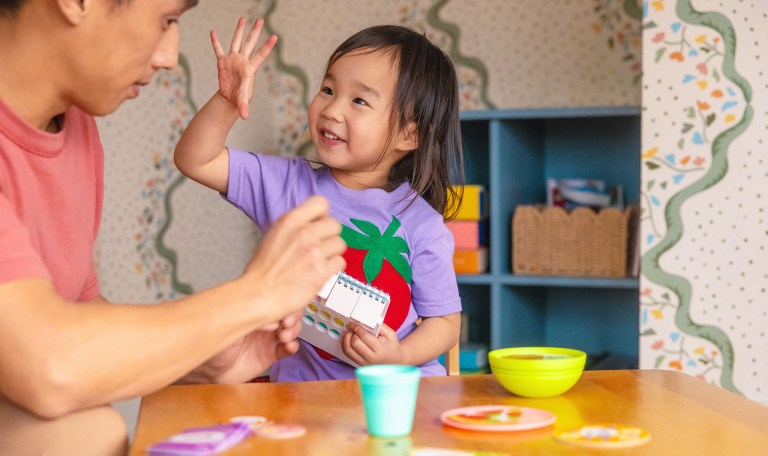
Does The Maths Skill Set actually help children learn maths? A new pilot study says yes
The Maths Skill Set pilot showed playful, hands-on learning boosted children’s confidence and numeracy, while parents observed greater enthusiasm, motivation, and joyful engagement with maths.
3-year-old
4 - 11 years
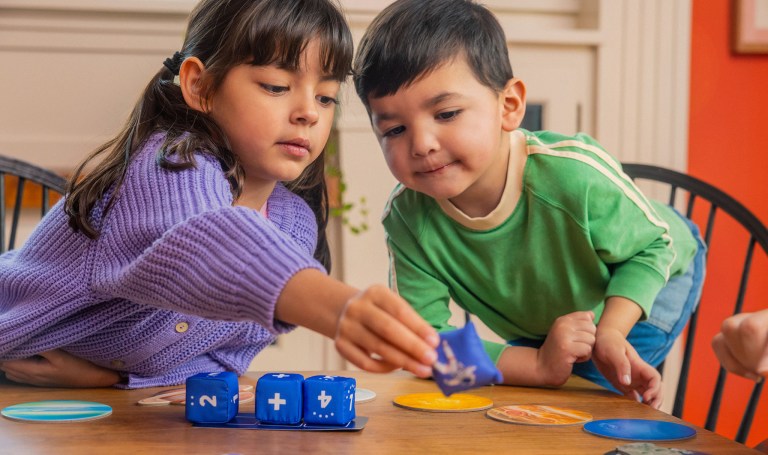
How to help your child get off to a strong start with maths
Lovevery’s Maths Skill Set helps children build confidence with numbers through playful, hands-on learning rooted in everyday life. Developed with leading maths experts, the programme strengthens foundational skills such as number sense, addition, measurement and problem-solving. By connecting maths to real experiences, children learn why maths works and how to use it.

4 - 11 years
4-year-old
New research shows The Reading Skill Set boosts children’s confidence and reading progress
Lovevery's phonics-based program helps children learn to read through play.