

RIE, Montessori, Reggio Emilia, & more—choosing the best educational approach for your child, by Lovevery CEO Jessica Rolph
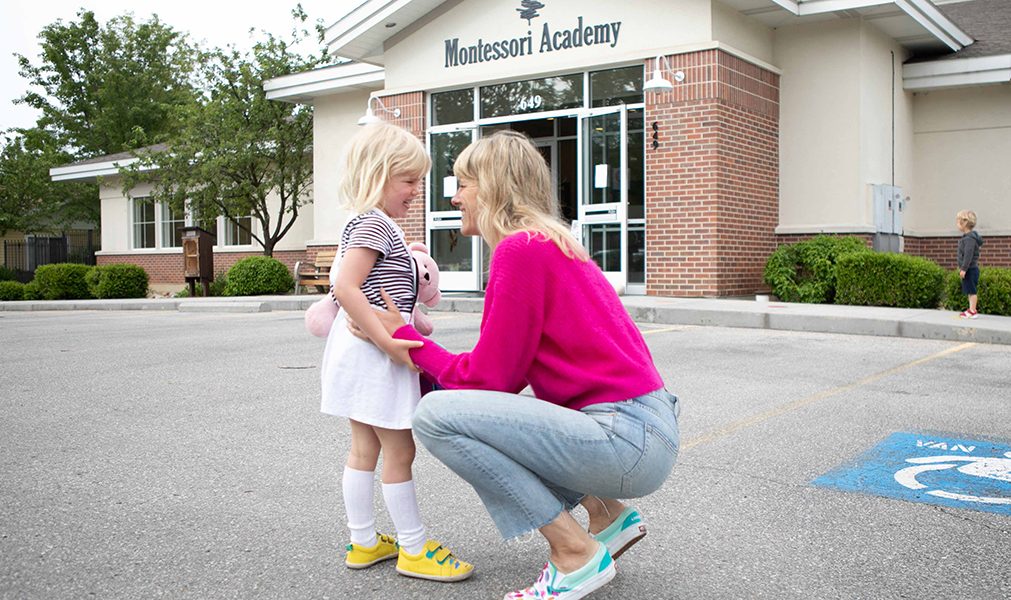
I was chatting with another mum the other day, and she described her family as a “Waldorf family.” I paused and started thinking: What does that actually mean? I send my own kids to Montessori schools, and—full disclosure—made the decision partly because it was the only programme that would take my not-yet-potty trained 2-year-old 🙃
I’ve read about and researched many of the early childhood philosophies. Though I’m not ready to completely accept or reject any of them, I found a lot to inspire and encourage me. Many of these methods can feel rigid—you’re either aligned or not. I understand the uncertainty I’ve heard from fellow parents: “Is this approach really consistent with our family’s goals and values?” To help me make informed decisions about childcare and also to get some new ideas to guide my own parenting, I wanted a clear summary of each philosophy.
I couldn’t find one, so I made one 🤓
The Montessori Method
Montessori activities and materials all build toward increasing independence through hands-on discovery and play, referred to as a child’s “work.” Children learn more from their experiences than they do from direct teaching, so adults are urged to get out of the way.
How it works:
- A hallmark of Montessori is allowing long stretches of time for children to be immersed in a self-driven task. In a Montessori environment, children choose from a carefully selected set of materials on a low shelf. They do their work—usually independently—on small mats to contain the space. The teacher demonstrates how to engage with the materials in a specific way, then steps back and allows the child to try it on their own.
- Materials are deliberate, thoughtful, and free of electronics.
- Children are given lots of choices throughout the day. They can self-select their own work and move freely throughout the room to explore pre-designated stations.
- The entire environment is carefully curated. Montessori classrooms are often beautiful, well-lit, visually pleasing spaces with what always feels like just the right amount of “stuff.” Montessori teachers believe that children can get deeper into play when they’re given minimal, carefully chosen materials on reachable shelves.
- Toys, books, and other playthings are regularly rotated in and out of the room. Here’s more on Montessori toy rotation.
- Children are combined in mixed-age groups. This helps minimise competition—every child learns at their own pace—and gives older children the chance to teach younger ones.
What I like:
- The materials used for learning are simple, beautiful, and deliberately designed for hands-on learning.
- The Practical Life work, like washing windows, doing dishes, sweeping and mopping, lacing, pouring, watering plants, is my favourite part of the curriculum. It tunes into what a small child naturally wants to practise.
What I question:
Imaginative play—including costumes, make believe, and fantasy—is dae-emphasized in Montessori. Yet children love dressing up and this kind of play is important for their brain development.
When my son was 4, he wanted to wear a superhero cape (with no characters) to school. At our Montessori, he wasn’t allowed to dress up. He was so disappointed one morning that I proposed a pair of knee-high socks he had with little capes coming out of the back ❤️ I called the school to ask permission and as I listened to myself negotiating with the front desk, I really felt there was a disconnect between philosophy and practise.
The RIE Method
The driving force behind RIE is respect—for the child, what they’re thinking and feeling, and what they can do with minimal instruction. RIE is about giving a baby or small child dignity through clear communication, independence, validation of feelings, and a recognition that they are already a person who deserves respect.
How it works:
- Caregivers don’t talk to babies and children as if they’re really babies and children. With RIE, you use a regular adult voice to describe in detail what you’re doing moment by moment. You can slow the pace of your speech a bit for a baby or toddler.
- The respect you show your child is on a whole new level. For instance, if you RIE, you’ll be asking your baby permission to change their diaper. It might go like this: “Baby, I am going to lay you down on the changing table. Is that okay with you?” The idaea is to show them that their body belongs to them and they deserve to be asked before something is done to them.
- Swings, play pens, sippy cups, and pacifiers are discouraged. According to the RIE philosophy, giving babies and small children crutches like these can actually undermine their natural skill development.
- Children should be given a “yes space” with just the right amount of playthings, at just the right difficulty and interest level for them—and where nothing is unsafe or forbidden. Children hear “no” a lot, so RIE encourages providing a designated area where they can explore without restrictions.
- RIE caregivers offer simple, timeless toys, like balls and blocks, and stay away from anything gimmicky, flashy, noisy, or overstimulating. “Untoys” are also favoured: Everyday items like pots and pans and other simple containers invite children to explore and engage with real objects and tools.
- Good manners are believed to result naturally from the RIE parenting style, rather than taught directly. A RIE parent wouldn’t remind a child to say “please” or “thank you”—they would just model it.
What I like:
- Teaching consent through respect and dignity is a meaningful intention that supports children’s developmental and emotional needs well beyond babyhood.
- Simple, open-ended toys without flashing lights allow babies and small children to come up with their own ways to play. These kinds of materials help build skills like focus, creativity, and problem-solving.
- RIE champions lots of empathy and full respect for a child’s feelings.
What I question:
- Tummy time is not encouraged in RIE, which goes against expert advice on babies’ physical development. This position could actually have been the result of a misunderstanding: Dr. Emmi Pikler, a paediatrician who advised RIE founder Magda Gerber, did include tummy time in her literature.
- “Yes” spaces, when they are static and overused, can start looking like a large play pen without much opportunity to explore.
- Communication with babies can sometimes feel flat in RIE. Because parents are encouraged to speak to their children as they would to an adult, babies miss out on the animated, expressive tones of “parentese.”
Reggio Emilia
This is probably the most child-directed of these educational philosophies, rooted in learning through open-ended play and free expression. Developed by educator Loris Malaguzzi and other parents in and around the Italian town of Reggio Emilia, the model focuses on respect for the child. It’s also based on a concept known as the “hundred languages,” which refers to nurturing the many ways children express themselves. Every child has their own way of making sense of the world, so they need a lot of opportunities for free play.
How it works:
- In Reggio Emilia, the child—not the teacher—is the centre of the classroom. Children get to choose most of their own learning paths based on interest.
- The “hundred languages” concept means that every child is encouraged to learn and communicate their ideas in a variety of ways beyond speaking and writing—including dance, art, and music.
- Community is an integral part of Reggio. Parents and caregivers are honoured as a child’s first teachers and included in every aspect of their education, from volunteering to curriculum development.
- The physical learning environment is critical—Malaguzzi viewed it as the “third teacher.” Common elements include natural light, open space, wooden toys and furniture, and displays of student work.
- Mistakes are celebrated as an active, essential part of the learning process.
What I like:
- Reggio Emilia respects the fact that every child learns differently, and that everyone has their own interests and ways of expressing themselves.
- The community-based model of education means that parents, teachers, and children form a united support team.
- Hands-on learning through play, discovery, art, and friendship is a wonderful way to grow.
What I question:
- Since there’s no formalised teacher certification process, it may be difficult to know how much training an instructor has.
- Similar to Waldorf, the lack of formalised education may scare off parents looking for a more traditional approach or hybrid.
Waldorf
Waldorf education is all about creativity, imagination, and disconnecting from technology. The use of simple tools and toys—often made of wood and other natural materials—activates a child’s innate sense of wonder and creativity. Singing, dancing, art, oral storytelling, and imagination games are hallmarks of Waldorf, as they all take precedence over screen time.
How it works:
- Children work with their teacher to create their own environment; curriculum shifts and changes as the group gets to know one another.
- Screen time isn’t allowed. No TV, movies, or electronic devices are permitted, either at school or home.
- There’s no formal reading or writing instruction until age 7, although elements of both skills are still taught. Teachers tell storeys with detailed language and complex vocabulary, creating language-rich environments. Children work on fine-motor skills by sewing and knitting rather than holding a pencil.
- Teachers often “loop” with their students, meaning they stay with the same cohort for years. The idaea is that they grow, learn, and teach together, enjoying a rich shared experience.
What I like:
- Waldorf classrooms are full of imagination, colour, creativity, and storytelling.
- It’s safe to experiment in a Waldorf classroom and topics are designed to follow a child’s natural curiosity.
- Traditional reading, writing, and math learning are postponed until later in elementary school, when a child’s brain is more ready for formal learning.
What I question:
- The focus on spoken language means storeys are told orally, often with puppets. This means that books are not usually introduced until later.
- The parent community is often very strong in Waldorf, which can feel isolating if you aren’t completely aligned.
- Of all the parenting styles, Waldorf can sometimes feel the most prescriptive. Schools highly encourage families to follow the programme at home, which can feel a bit rigid.
Forest Schools
Forest Schools believe in immersing children in nature for as long and often as possible. According to this approach, being outside helps them with self-regulation and empowers them to take both physical and emotional risks. Forest Schools place emphasis on growing relationships, making choices, and practicing independence in a natural setting.
How it works:
- Children are outside all day, no matter what, and are asked to come to school in appropriate clothing. Except in cases of extreme weather, Forest Schools don’t close down when it rains, snows, or gets windy. Instead, the environmental conditions are incorporated into lessons and learning. For example, mud play becomes a focus when it rains.
- The pace of learning is as fast or as slow as a particular group of children needs it to be: There are no strict timetables for learning and no formal assessments. Children are encouraged to learn at their own pace and explore what they love—the programme is play-based and child-directed.
- Forest School teachers are seen as facilitators of learning rather than directors and are specially trained in the outdoors. They know how to teach, learn, and survive outside.
What I like:
- Neuroscience indicates that time in nature is inherently healthy; being outside encourages positivity and helps with emotional regulation, confidence, and resilience.
- Because they are outdoors for hours, children get more exercise than those in a traditional school. They move, run, dance, and play for much of the day, though children who would rather sit and draw are free to do that.
What I question:
- If you’re in the heart of a big city or an extreme climate, getting close to nature might not be easy. A Forest School philosophy is adaptable to any environment in theory. But in practise, you really need green spaces and mostly mellow weather to get the most out of the experience.
- Adapting to a more traditional indoor classroom environment for grade school could be a challenge.


Keep reading
3-year-old
4-year-old
Why experts recommend phonics to teach reading
Phonics is an essential part of an evidence-based approach to reading instruction. Learn more about phonics and why it matters.

3-year-old
4-year-old
3 ways you may already be helping your child learn to read – and what to try next
Reading books, singing songs, and reciting the alphabet are all important practices you may already be doing. Try these simple ways to broaden and deepen their early reading experiences.
3-year-old
4-year-old
My child just lied—what should I do?
Research shows 90% of children have lied by age 4. Here are 3 tips to encourage honesty in your preschooler.