

Here’s how to make the most of playtime with your preschooler

Is your child heading off to preschool? This can be an exciting time in their life—and yours—as they start down a path of more formal learning. But even after they start preschool, studies show quality playtime at home continues to have a big impact on their development. While the school environment is more structured, they get more time for important self-directed play—and the benefit of individual guidance—at home. They still have a lot to learn from their playthings and from you.
How to make the most of playtime at home
Ask different types of questions to spark new learning
Young children often learn best through their own discovery, but just a few well-timed, open-ended questions as they play can help get them thinking critically. For example, as you and your child build with blocks, you might ask: “What will happen if we put this big block on top?” or “Hmm, which tower is taller? What could we do to make the two towers the same height?” Closed-ended questions can also help reinforce concepts, like colors or shapes: When your child puts together two matching pieces of the Land And Sky Two-Part Puzzle Board, you might say, “Oh, look! What shape did those pieces make?”
Let your child’s interests take center stage
At preschool, your child can’t always dive deep into what specifically interests them in the same way they can at home. Tapping into their enthusiasm can be a springboard to more meaningful learning and exploration.
For example, if your child loves butterflies, grab the one from the Quilted Critter Pockets and take it on a pollinating adventure. Spread out the flowers from Felt Flowers in a Row around a room, then encourage your child to have the butterfly float from flower to flower.
Have a child who’s into vehicles? Use the Wooden Camper With Locking Doors to create a hidden math activity. Simply draw chalk “roads” in differing lengths on pavement and use them to explore comparison words: “Your camper went so far on this road—it’s long!” or “Look! This road is so short. Your camper can move down it so fast!”
Emphasize learning through doing
At this age, your child learns best through hands-on learning—engaging with tangible materials to understand concepts like numbers, spatial relationships, and how objects work together. For example, you can turn bath time into a science lesson in disguise with the containers from the Liquid Lab. As your child pours the pitcher of water into the tall cylinder, they’ll notice a lot of overflow. Then, when they pour from the cylinder back into the pitcher, only a third of the pitcher will fill. This splishing and splashing can help your child experiment with the concept of conservation—that the amount of water stays the same even if it changes shape.
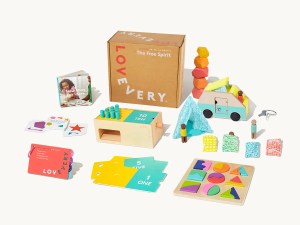
The Free Spirit Play Kit
The Free Spirit Play Kit celebrates this stage with playthings that empower independence, encourage curiosity, and strengthen executive functioning. See what’s inside The Free Spirit Play Kit!
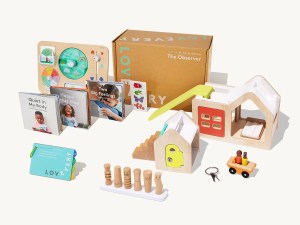
The Observer Play Kit
Welcome your new three-year-old to the “Year of the Self” as they take ownership of their routines, build emotional intelligence, and make sense of their world through open-ended play.
Learn more about the research
Ferrara, K., Hirsh-Pasek, K., Newcombe, N. S., Golinkoff, R. M., & Lam, W. S. (2011). Block talk: Spatial language during block play. Mind, Brain, and Education, 5(3), 143-151.
Frazier, B. N., Gelman, S. A., & Wellman, H. M. (2009). Preschoolers’ search for explanatory information within adult-child conversation. Child Development, 80(6), 1592.
Hirsh-Pasek, K. (2009). A Mandate for Playful Learning in Preschool: Applying the Scientific Evidence. United Kingdom: Oxford University Press, USA.
Trawick-Smith, J., & Waite, P. (2009). Science in support of play: The case for play-based preschool programs. The Center for Early Childhood Education, white paper. Fall.
Vandermaas-Peeler, M., Mischka, M., & Sands, K. (2019). ‘What do you notice?’Parent guidance of preschoolers’ inquiry in activities at home. Early Child Development and Care, 189(2), 220-232.

Posted in: 2-year-old, 3-year-old, 34 - 36 Months, 37 - 39 Months, 4-year-old, Parent & Family Life
Keep reading

4 - 11 years
4-year-old
New research shows The Reading Skill Set boosts children’s confidence and reading progress
Lovevery's phonics-based program helps children learn to read through play.
3-year-old
4-year-old
Why experts recommend phonics to teach reading
Phonics is an essential part of an evidence-based approach to reading instruction. Learn more about phonics and why it matters.

3-year-old
4-year-old
3 ways you may already be helping your child learn to read – and what to try next
Reading books, singing songs, and reciting the alphabet are all important practices you may already be doing. Try these simple ways to broaden and deepen their early reading experiences.