

Simple ideas for pretend play at age 2.5
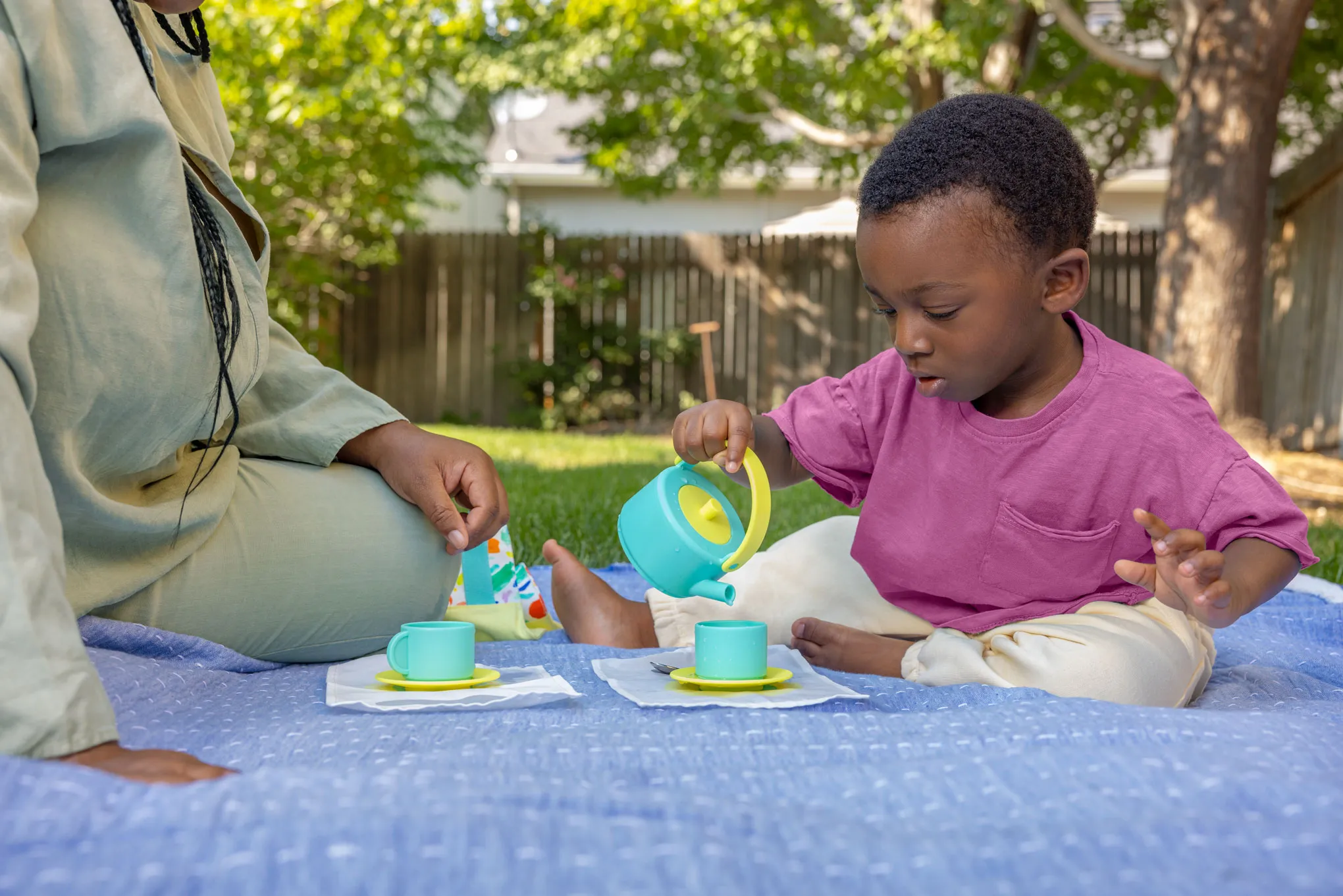
Just like other types of development, pretend play happens in stages. At around 18 to 24 months, your child may have picked up a block and held it up to their ear like a phone. Soon, you may start to see them pretend to be someone else they know, like their doctor or teacher. This happens as your child gains both the experience and the working memory to recall it.
Here are 3 ideas for pretending with your 2-year-old:

Mailbox
Mail delivery tends to be pretty exciting for young children. Your 2-year-old may already insist on bringing the mail in from the mailbox or want to be in charge of letters dropped through the door slot.
Set up a few “mailboxes”—just a simple box or container will work—around your home for specific people, pets, or even stuffed animals. You can put a mailbox by the dog’s bed, by Mama’s desk, and by the dollhouse where their peg people live. Hand your child some junk mail, magazines, or scratch paper “letters” and ask them to deliver the mail.
Children at this age often love writing their own letters. Even if they’re just scribbling, encouraging them to write empowers them to think of themselves as writers.
Tea party
Tea parties are a classic for a reason: They can be done anywhere and anytime, and invite all kinds of pretend play. Serve imaginary steaming hot tea, put your pinkies up, and enjoy a party with your child and any stuffies they may want to invite. Try using the wooden coins from the Drop & Match Dot Catcher to stand in for cookies and finger sandwiches.
Nature play
When you’re outside with your child—or even indoors watching a storm—point out the branches waving, the leaves rustling, and drops of rainwater sliding down the window panes. Invite your child to imitate what you see in rhythmic ways:
- Sway like a tree
- Slide down like water on a pane of glass
- Chirp the sounds of a bird
- Tap and drum on a surface to imitate the rain
- Pretend to gobble up nuts like a squirrel

Learn more about the research
Goldstein, T. R., & Lerner, M. D. (2018). Dramatic pretend play games uniquely improve emotional control in young children. Developmental science, 21(4), e12603.
Quinn, S., Donnelly, S., & Kidd, E. (2018). The relationship between symbolic play and language acquisition: A meta-analytic review. Developmental review, 49, 121-135.Weisberg, D. S. (2015). Pretend play. Wiley Interdisciplinary Reviews: Cognitive Science, 6(3), 249-261.

Posted in: 34 - 36 Months, Indoor Play, playtime, Pretend Play, types of play, weekly-series, Play & Activities
Keep reading

2-year-old
3-year-old
34 - 36 Months
Do this quick prep for a peaceful playdate
Playdates are a great time to develop social skills like building friendships and taking turns. Here's how to support your child before and during a playdate.

3-year-old
34 - 36 Months
Planning ahead: a key skill your 3-year-old is developing now
If your child notices it’s raining and tells you they need an umbrella, they’re showing a small sign of a big cognitive skill that emerges during the 3-year-old year—thinking ahead.

2-year-old
34 - 36 Months
An expert guide to nighttime potty learning
There’s a lot you can do to help your child with potty learning during the day—but once they fall asleep, your role in helping them stay dry takes a backseat to biology.