

Real Life Play Kitchen: 7 ways to help your child be responsible with running water
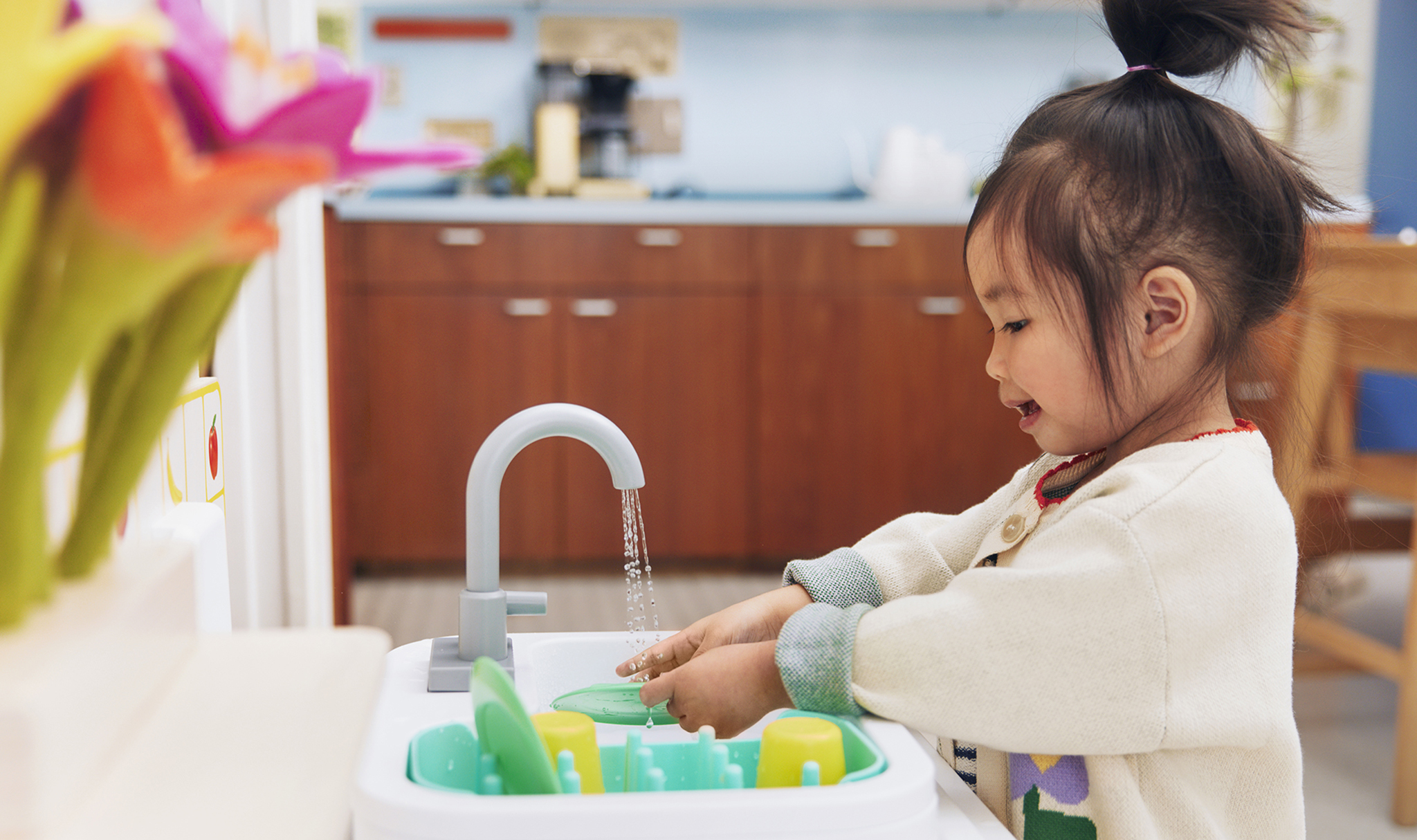
Sensory play holds a special fascination for children, which is why we designed The Real Life Play Kitchen to include running water. Having their own kitchen space—including a working sink— gives your child an opportunity to develop practical life skills like washing their hands, preparing a simple snack, and filling their water bottle. At the same time, they can learn how to clean up their own spills and turn off the faucet when they’re done. Here are our top tips for helping your child be more independent—and responsible—with their own source of running water ❤️
- You decide when and how much water to offer. The Real Life Play Kitchen doesn’t provide unlimited access to water. You can control how much water goes in the fresh water tank and when to add more. For example, you can add some in the morning and let your child know, “This is all your water for today.” Or, you may decide to add fresh water midday or before the evening routine so they can complete self-care tasks or help with dinner prep. Just be sure to empty the used water basin first 😉
- Begin with just a cup or two at a time. Adding water to the tank out of your child’s view helps them understand that once the tank runs out, the water is all gone. Depending on your child’s age and your comfort level, you can gradually work up to filling the tank to capacity.
- Practise turning the faucet on and off. Play a simple game: Turn on the faucet and say “water on.” Turn it off again and say “water off.” Then, invite your child to try, repeating the words “on” and “off.” Point out how the water tank level goes down as the water runs.
- Establish simple rules. For example, you can say, “Water stays in the sink” or “Water goes off when you’re all done.” Repeat the rules each time they play and use logical consequences if they test the boundaries: “If the water leaves the sink, I will put it away for the day.”
- Gradually give them more independence. You’ll likely need to help a younger child with even simple tasks, like washing hands. For older children, try demonstrating the steps of a task like filling their own water bottle a few times, then gradually let them take over. Watch your child to see where they need your assistance or wait for them to ask for help. Then, offer just enough support so they can be successful on their own.
- Make cleanup part of the play. Cleanup tasks may feel like a chore to adults, but your child will likely welcome the opportunity to take care of their kitchen space, just like you. ❤️ For example, they can use the dish towel that comes with The Real Life Play Kitchen to dry their dishes or wipe up any drips and spills. You may want a few more small towels or washcloths in a basket nearby so you or your child can clean up easily as they play or work.
- Refill the tank and empty the used water bin yourself. Though your child can help with most clean up activities, dumping the used water bin and refilling the tank should be jobs for adults alone. Because you don’t want your child to mimic these actions, do the dumping and refilling when they’re out of the room. You’ll know it’s time to empty the used water tank when you see the red stopper.


Keep reading
3-year-old
4 - 11 years
Does The Maths Skill Set actually help children learn maths? A new pilot study says yes
The Maths Skill Set pilot showed playful, hands-on learning boosted children’s confidence and numeracy, while parents observed greater enthusiasm, motivation, and joyful engagement with maths.
3-year-old
4 - 11 years
How to help your child get off to a strong start with maths
Lovevery’s Maths Skill Set helps children build confidence with numbers through playful, hands-on learning rooted in everyday life. Developed with leading maths experts, the programme strengthens foundational skills such as number sense, addition, measurement and problem-solving. By connecting maths to real experiences, children learn why maths works and how to use it.

4-year-old
Welcome to The Planner Play Kit for 4-year olds
The Planner Play Kit taps into your child’s growing awareness and offers ways to practice thinking ahead. Through play, your child learns to map out a sequence of steps to reach their goal.